
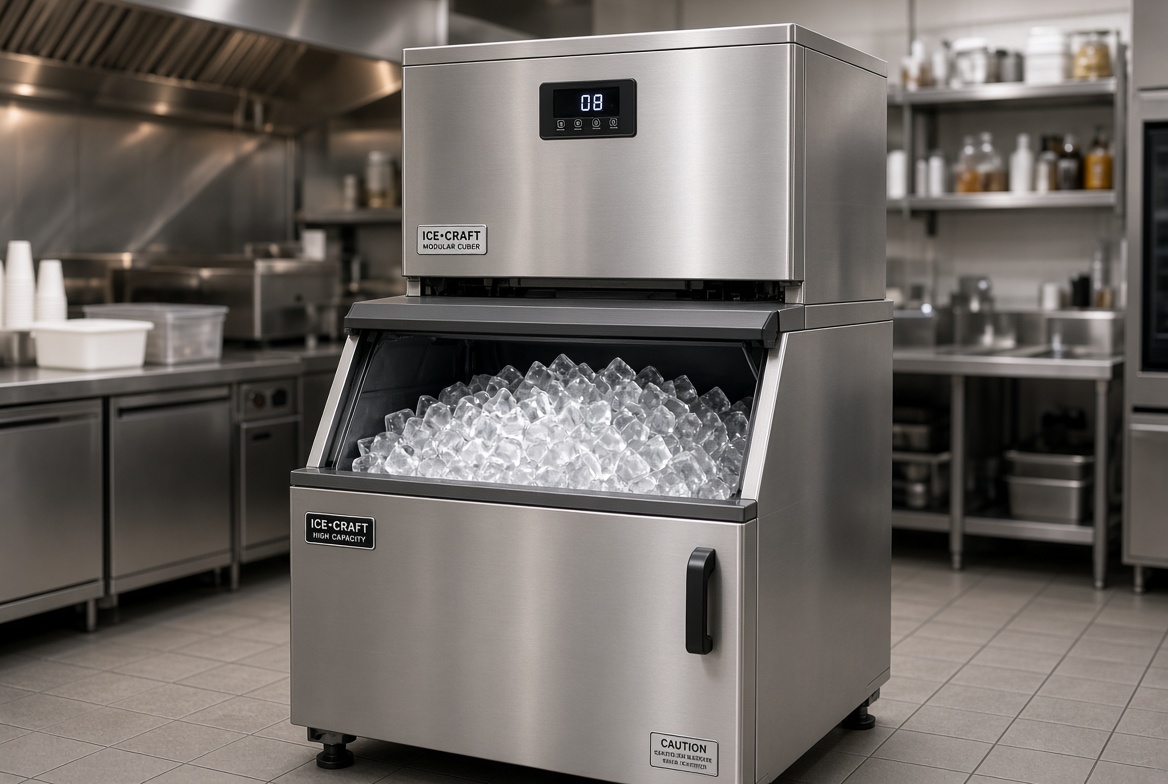
They are built for high-demand environments such as restaurants, bars, hotels, hospitals, convenience stores, offices, healthcare facilities, and foodservice operations. Unlike residential units (which typically produce 10–50 lbs of ice per day for occasional use), commercial models are engineered for 24/7 operation, higher durability, better hygiene standards, and production capacities ranging from about 50 lbs per day up to 1,000–5,000+ lbs per day depending on the model and scale.
How They Work
Water is supplied (usually via a permanent connection to a water line, though some smaller units allow manual filling). The water is filtered, then frozen on refrigerated evaporator plates or in specialized molds. Once formed, a brief heating or harvest cycle releases the ice into a storage bin. Sensors often detect when the bin is full and pause production to save energy and water.
Main Types of Commercial Ice Machines
- Modular (or “head”) units — The ice-making section sits on top of a separate storage bin or dispenser. These offer the highest capacity and flexibility (production and storage can be sized independently). Ideal for high-volume restaurants, hotels, and banquet facilities (often 250–2,000+ lbs/day).
- Self-contained / undercounter units — Ice maker and storage bin are combined in one compact cabinet that fits under a counter. Best for bars, cafés, small restaurants, or limited-space locations (typically 50–500 lbs/day).
- Countertop or freestanding dispensers — Compact units that produce and dispense ice (sometimes with water) directly into cups or containers. Popular in offices, cafeterias, healthcare, and self-service areas for hygiene and convenience.
- Specialty or industrial-grade models — Higher-capacity versions for very large operations, sometimes with bagging or outdoor/vending capabilities.
Types of Ice Produced
Commercial machines can make several styles of ice, each suited to different uses:
- Cube / half-cube / dice / crescent — Hard, clear ice that melts relatively slowly; standard for drinks, cocktails, and general beverage service.
- Nugget / cubelet / chewable — Soft, porous pellets that are easy to chew; popular in healthcare, soft drinks, smoothies, and fast-casual settings.
- Flake — Soft, moldable ice ideal for seafood displays, salad bars, food chilling, and medical applications.
- Gourmet / specialty shapes — Larger, slower-melting cubes or unique forms for premium bars and high-end service.
Key Differences from Residential Ice Makers
| Aspect | Commercial | Residential |
|---|---|---|
| Capacity | High (50–5,000+ lbs/day) | Low (typically under 50 lbs/day) |
| Durability | Built for continuous heavy use | Lighter-duty, intermittent use |
| Installation | Often needs professional plumbing & drain | Usually plug-and-play |
| Ice variety | Multiple specialized types | Mostly standard cubes |
| Hygiene & standards | NSF-certified, designed for food safety | Basic household standards |
| Cost & maintenance | Higher upfront cost; regular professional cleaning | Lower cost; simpler upkeep |
Commercial units also commonly feature stainless-steel construction, energy-efficient designs (many ENERGY STAR rated), air- or water-cooled condensers, and advanced filtration for clearer, cleaner ice.
In short, commercial ice machines are specialized production equipment that keep businesses supplied with reliable, sanitary ice for drinks, food presentation, cooling, and customer service. Choosing the right one depends on daily ice demand, available space, the preferred ice type, and the specific industry needs.